What to Notice on a Country Walk Without Making It a Scavenger Hunt
A country walk checklist can keep practical details in view while a simple route prompt helps you notice changing boundaries, sounds, and signs of use.
What should a country walk checklist help you notice without turning the lane into a scavenger hunt? Use it to check practical details before you leave, then choose one feature of the countryside to follow loosely as you walk. That leaves room for a gate, a sudden gust, or an unexpected view to catch your attention.
Check the practical details
A short checklist is useful for decisions that affect the outing, not for collecting every flower or bird along the way. Before setting out, check the route, access, and conditions; if something is uncertain, choose a clearer path or adjust your plans.
- Check the route on a map; if it follows a public right of way or clearly marked access, use it, but if access is unclear, choose a confirmed route instead.
- Check local signs and closures; if the path is open, follow its directions, but if it is closed or restricted, turn back or take an open alternative.
- Check the forecast and the ground underfoot; if conditions suit your footwear and route, continue, but if the path looks unsafe or exposed, shorten the walk or choose a sheltered option.
- Check whether a gate, livestock, or a narrow passage requires care; if so, follow posted instructions and pass quietly, but if you cannot do so safely, keep your distance and use another route.
- Check dog-access rules before bringing a dog; if dogs are allowed, keep yours under control as signs require, but if they are not, leave the dog at home or choose another path.
- Check that you have a map or a phone with route information; if you can consult it when needed, set out, but if not, choose a route you can follow confidently or bring a suitable map.
These checks are worth doing because they lead to a clear choice: proceed, adapt, or turn back. It is not worth the effort to make a tally sheet of every possible landscape feature if your purpose is an unhurried walk.
Pick a loose prompt
Once the practical decisions are settled, give your attention a broad subject: boundaries, shelter, sound, or signs of water. A prompt should be easy to notice in more than one way. “Where does the lane feel sheltered?” might lead you to a hedge, a dip in the ground, or a bend that blocks the wind.
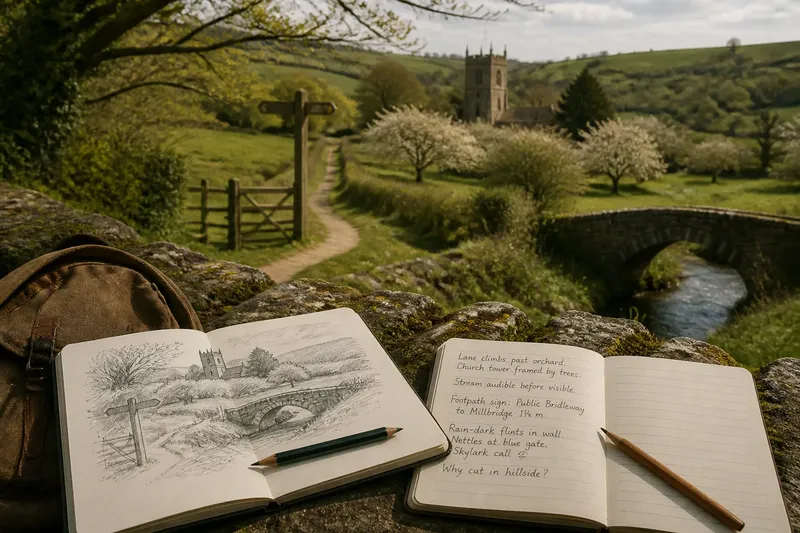
Keep it distinct from a sketchbook project or a record-making task. You do not need to draw, photograph, or write down each observation; the point is to let one feature shape how you experience the route, not to produce an account of it.
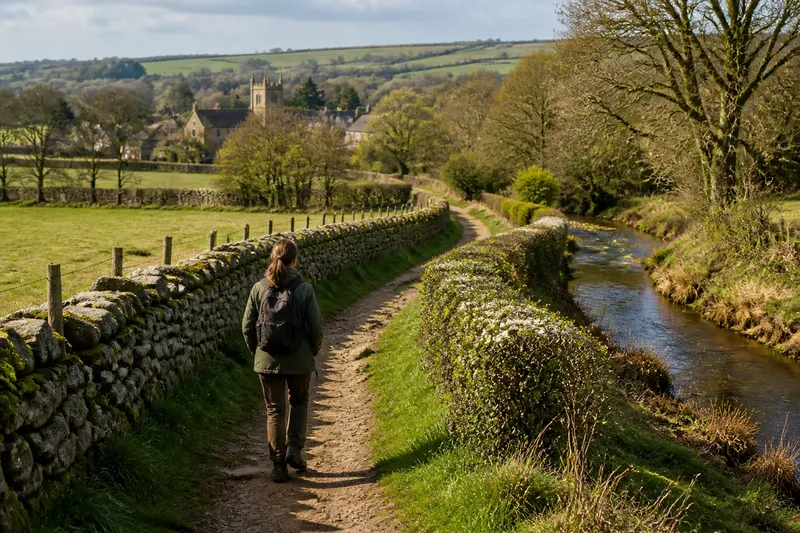
Imagine you start at a village lane with a stone wall beside you and choose “boundaries” as your prompt. You walk toward a stream, notice the wall become a hawthorn hedge, then see the path edge soften into a muddy bank. The result is a simple decision about what to pay attention to—the changing edge—not a requirement to identify or document every plant along it.
Let the place interrupt
Begin at an ordinary pace and take in the whole scene before looking for your chosen feature. A lane may feel enclosed, open, busy, or quiet; that first impression gives your prompt a setting rather than making it a filter.
Then follow the prompt lightly. For “sound,” notice how a road’s noise changes behind a hedge or across an open field. For “water,” look at a stream if one is visible, but also notice damp ground or a drainage channel without treating each as a box to tick.
If a tractor crosses a field or a church bell carries across the village, let that moment take your attention, even if it does not fit the prompt. A walk can change direction without changing course.
Country walk checklist questions?
What should I include in a country walk checklist?
Include practical checks such as route access, signs, ground conditions, relevant dog rules, and a way to consult your route. For landscape observation, choose one broad prompt rather than a long list of things to find.
How do I choose a walking prompt?
Pick a subject you are curious about that can appear in different forms, such as shelter or boundaries. If it starts to feel like a task, set it aside and walk on.
What if my prompt does not appear?
Let it fade instead of searching harder or doubling back. A dry route may offer little visible water, for instance, and you can simply notice the slope, continue walking, or switch to a different feature.
Should I write down what I notice?
Only if a brief note serves a purpose for you. If stopping to write disrupts the walk, keep the impression in mind or leave it unrecorded.
Leave with one impression
Near the end, notice whether the route feels different from the way it did at the start. Perhaps the hedges made the lane feel more sheltered, or the path’s edges changed as it approached water. You do not need to decide that the prompt was a success.
If you want a record, one sentence is enough: “The path’s edges softened as the wall gave way to reeds.” That captures a relationship between features without pretending to describe the whole place.
A country walk checklist works best when it settles practical questions before they distract you. After that, one loose prompt can guide your attention—and the route, rather than a tally, can decide what you notice next.