Why a Village Green Invites People to Linger
Why a village green invites people to linger: learn how paths, sightlines, and shared space make it easy to watch a game, read, or settle into conversation.
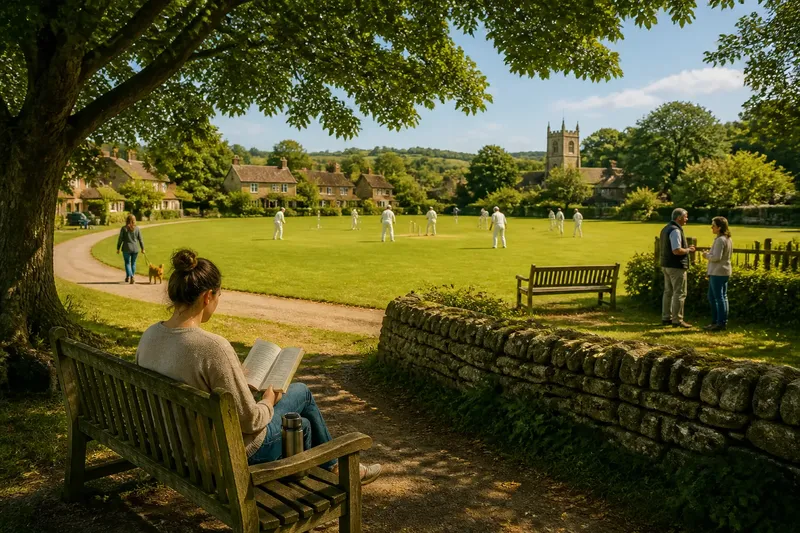
Why a village green invites people to linger is easiest to see from its edge: a cricket match may occupy the middle, a dog walker follows the path, and someone reads beneath a tree without joining either. The green gives each activity room to unfold while keeping its ordinary village bustle in view. Its charm lies less in doing nothing than in having several small things to notice.
Small details hold attention
A green offers a changing scene without demanding a ticket, a schedule, or a seat facing one fixed attraction. You might watch a child invent a game with fallen leaves, hear a gate click as a neighbor crosses, then turn back to your book. Each detail is modest; together, they give a pause texture.
The layout shapes what catches your eye. A tree canopy frames the open ground, a path carries movement through the view, and a bench lets you settle without standing in the way. Even a low stone wall can become a natural perch, as long as it is comfortable and does not block a route.
Not every green has a bench, a broad lawn, or a dramatic old tree. A narrow common with a clear view of the lane can hold attention just as well. The useful question is what the place lets you notice, not whether it matches a postcard.
Shared space, separate pursuits
On a village green, people often use the same ground for different reasons. A group may kick a ball around while a walker cuts across the path and a couple chats by the hedge. The arrangement works best when everyone leaves room for others to pass and avoids treating the whole green as private territory.
That mix gives a visitor choices. You can sit near the action and watch, pick a quieter boundary for reading, or take a slow circuit before settling. A green does not need a formal program to feel occupied; the ordinary rhythm of neighbors crossing paths can provide enough movement.
For a group, a loose arrangement is often more considerate than spreading bags and chairs across the lawn. Keep a clear route around the gathering and leave open ground for people who want to walk through. If a game is underway, choose a spot outside its likely path rather than assuming others will change course.
Choose a view that suits
A seat beside a path makes it easy to notice passersby, while a place near a boundary can feel less exposed. From a bench under a tree, you might see the entrance and the open center without sitting directly in the busiest area. The best position depends on whether you want conversation, a view of play, or a little shelter from movement.
Think about sightlines as well as comfort. A parent watching children may prefer a clear view across the lawn; someone reading may want a position where the main path is visible but not directly behind the page. There is no need to see the entire green. A view of the route you plan to use and the activity you care about is usually enough.
Say you arrive at a small green with a book, a thermos, and twenty minutes before meeting a friend; those are invented details for this example, not a report of a real visit. You notice that the only bench faces the busy path, while a broad tree sits near the quieter edge. First, you check that the tree’s shade does not obscure the entrance; then you sit where you can see both the path and the open ground. If your friend approaches, you can spot them; if the path grows noisy, you can move to the far side of the tree. The tradeoff is a less direct view of the center in exchange for a calmer reading spot.
Which spot fits your visit?
Where can I watch a game?
Choose a bench or boundary spot with a clear view of the playing area, but stay outside the likely route of the ball. If the game expands toward you, move rather than expecting players to work around your seat.
Where can I read quietly?
Look for a place near a tree, hedge, or low wall that remains within sight of a path. If conversation or play carries over, shift to another edge instead of trying to claim a quiet zone on a shared green.
What should I bring for a short visit?
A book, a drink in a secure container, or a light layer may be enough, depending on the weather and local rules. If you plan to play a game, bring only what fits the space and pack it away if others need the ground.
What if the green is busy?
Watch briefly for open space and choose a spot that does not cut across a game or gathering. If every area feels crowded, take a short walk nearby and return later, or choose another place to pause.
Read the ground first
- Check whether a path crosses your chosen sitting area; if it does, move to the side so walkers have a clear route, and use the original spot only if the path is unobstructed.
- Check where a ball or running game is likely to travel; if your seat falls in that line, shift beyond the play area, and stay only if the activity leaves your position clear.
- Check whether tree shade covers the spot you want; if it does and you prefer shade, settle there, but move to an open bench if you want sun or a clearer view.
- Check whether a bench faces the activity you came to watch; if it does not, choose a different seat or stand at the edge, and keep the bench if comfort matters more than the view.
- Check whether your gathering leaves space for people passing through; if it does not, tighten the group or move closer together, and use another area if no clear route remains.
- Check for signs about dogs, ball games, or other local rules; if a sign limits your planned activity, follow the restriction and choose an allowed pastime, or visit another space if none suits.
What is not worth the effort is packing an elaborate kit for an ordinary pause or searching for a perfect seat before you have seen how the green is being used. A quick look at the paths, shade, and activity usually tells you enough to choose.
Let the visit take shape
Weather and village routines change the feel of a green. A breezy corner may suit a walk, while a sheltered bench works better for a longer read; after rain, a paved edge may be more comfortable than soft ground. Notice the conditions when you arrive rather than relying on a memory of how the place felt on another day.
Why a village green invites people to linger comes down to this balance: you can follow a game, greet someone, read, or simply watch the paths without needing to make the whole visit about one activity. Leave room for the next person to use the space, and the green can keep its small, shifting scene in motion.