Sketchbook or Field Notebook for a Country Walk?
Choose a sketchbook or field notebook for a country walk by matching the page to what you want to remember: landscape shapes, local details, or sounds.
Should you carry a sketchbook or a field notebook on a country walk? A sketchbook or field notebook can help you bring home different things: the shape of a hedgerow, a footpath sign’s wording, or the sound of water hidden beneath a bridge. The choice is less about talent than about which kind of record you want to make.
A sketchbook gives you room to place shapes in relation to one another. A field notebook makes it easy to collect words, names, and observations as the walk unfolds. Either can be simple: a pencil and a page are enough to begin.
Choose by memory
Pick a sketchbook when you want to remember how a place is arranged: a church tower between trees, a stream below a field, or a cottage behind a high garden wall. A few lines can hold the view’s structure in a way a list of nouns may not.
Pick a field notebook when particular details matter more than their positions. You might note rain-darkened flints in a wall, a sign beside a bridleway, or a skylark’s call carrying over an open field. Words also preserve names, questions, and the thoughts a drawing may leave out.
The formats can overlap, but each has a natural strength. A small route sketch can clarify a written entry; a caption can explain a drawing. Decide which one should do most of the work, rather than treating every page as a test of what you can record.
What sketches show
Drawing is useful for relationships between forms. A quick outline can show where a lane dips, how trees follow a ridge, or how a gate interrupts a long stone wall. The result need only make sense to you later.
Use uncomplicated marks: a long stroke for a hedge, a dark patch for trees, or broken lines for rough stone. Add an arrow or a label if it clarifies what you are looking at. You are making a visual reminder, not an illustration for display.
A sketchbook suits a walk with views that change as you move, especially when you want to compare a bend, silhouette, or arrangement of buildings. Its limitation is selectivity: a drawing may not preserve a bird call, a place name, or why a certain view caught your attention. A short caption can restore some of that context.
What notes hold
A field notebook is well suited to particulars: a gate painted blue, nettles leaning through its bars, or rain ticking on broad leaves. Specific nouns and verbs make a page easier to understand when you return to it.
Writing also follows the movement of a walk. You can record what changed after a footpath crossed a brook, what you heard before the trees opened, or a question prompted by an old-looking cut in a hillside. Mark an uncertain thought as a question rather than turning it into a claim.
Broad impressions can be hard to use later. “Lovely lane” may capture a mood, but “pale gravel, high hedges, and a gate with a rusted latch” gives your memory something concrete to hold. A few well-chosen details are often clearer than a running account of every passing sight.
Fit the walk
Consider how you will use the page as well as what you want to preserve. A hard-backed notebook is easier to write in while standing; a sketchbook with a firm cover can support a pencil drawing. A soft pencil works for both, and an eraser is useful if you prefer to revise a line. If drizzle is likely, keep the paper in a protective cover.
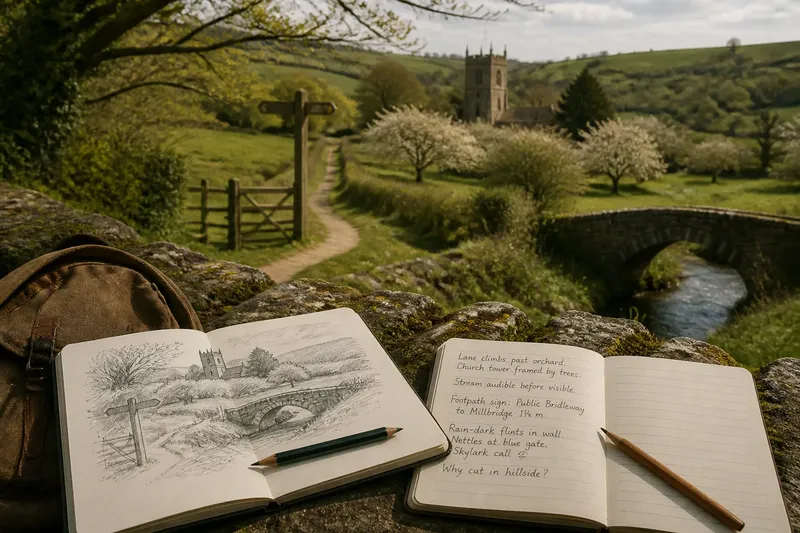
Say you are walking a fictional lane that climbs past an orchard and turns beside a stream. You want to remember how dark branches frame a church tower, so you draw the orchard and tower as three simple shapes, then write “stream audible before visible” beneath them. The sketch preserves the view’s arrangement; the sentence supplies a sound and a moment in the route. A single page serves both purposes without asking either format to do everything.
If you prefer to carry only one book, borrow a small feature from the other format. Leave a margin in your notebook for a route squiggle, or reserve a line below a sketch for a place name and a sound. Keep each addition tied to a detail you genuinely want to recall.
Questions about pages?
Can I draw without art experience?
Yes. Use lines, shapes, and labels as private reminders rather than aiming for a polished picture. A rough bridge outline with a note about its setting can be more useful than careful shading without context.
What belongs in a field notebook?
Write down details you can recognize later, such as a place name, a distinctive feature, a sound, or a change in weather. If you are unsure what something is, record what you observed and leave the identification open.
Should I carry one book or both?
One book is enough if you want to keep your kit light or tend to favor either drawing or writing. Carry both only if you enjoy using each and the extra book will not distract from the walk.
Which format suits a brief pause?
Choose the one you can use without much setup. A short caption captures a passing sound or detail; a few outline marks preserve a view’s arrangement.
Make a clear choice?
Before setting out, ask what kind of memory you most want to keep: a scene’s layout or its specific details. If you cannot decide, use this compact set of checks; each one points to a practical choice.
- If a view’s shapes and positions are what you want to recall, then take a sketchbook; if names or sounds matter more, take a field notebook.
- If you expect to write while standing, then choose a notebook with a firm cover; if you plan to draw, choose a sketchbook that supports its pages.
- If drizzle is likely, then protect either book in a cover; if conditions are dry, carry the format you prefer without extra weatherproofing.
- If place names or sign wording are important, then leave space for written labels; if the view itself matters most, reserve the page for a sketch.
- If you want to preserve a sequence of changes along the route, then use a notebook; if one particular view stands out, make a sketch.
- If carrying two books feels distracting, then take one and add a caption or small route drawing; if you naturally use both, give each a distinct purpose.
It is not worth trying to record every gate, tree, and turn. That can turn a pleasant pause into an assignment. Choose a scene or detail that would help you recognize the walk later, and let the rest remain in the landscape.
For a country walk, a sketchbook is the stronger choice when you want to preserve shapes and spatial relationships; a field notebook is better for words, sounds, names, and questions. The useful question is not how much you can fit on the page, but which details will make the place recognizable to you when you open the book again.